Why some neurons are more vulnerable to inflammation
Linking DNA damage and repair to the selective loss of cortical neurons.
Explore the finding

Studying genome instability in neurodegeneration and ageing
Our mission is to improve the lives of people affected by brain disease through discoveries that protect brain health.
Understanding how neurons maintain their genomes throughout life.
We study genome instability in neurodegeneration and ageing, asking how neurons maintain their DNA and function throughout life. Alongside genetic screens and human cell and mouse models, our work on the naked mole-rat explores the biology of healthy brain ageing. Our aim is to understand what makes neurons vulnerable and what helps preserve brain health over time.
The Balmus Laboratory studies the DNA damage response in mature neurons. These long-lived cells face a particular challenge: protecting their genetic material over a lifetime.
We explore how neurons respond to endogenous genotoxic stress, how these responses change in disease, and which repair pathways influence neuronal survival.
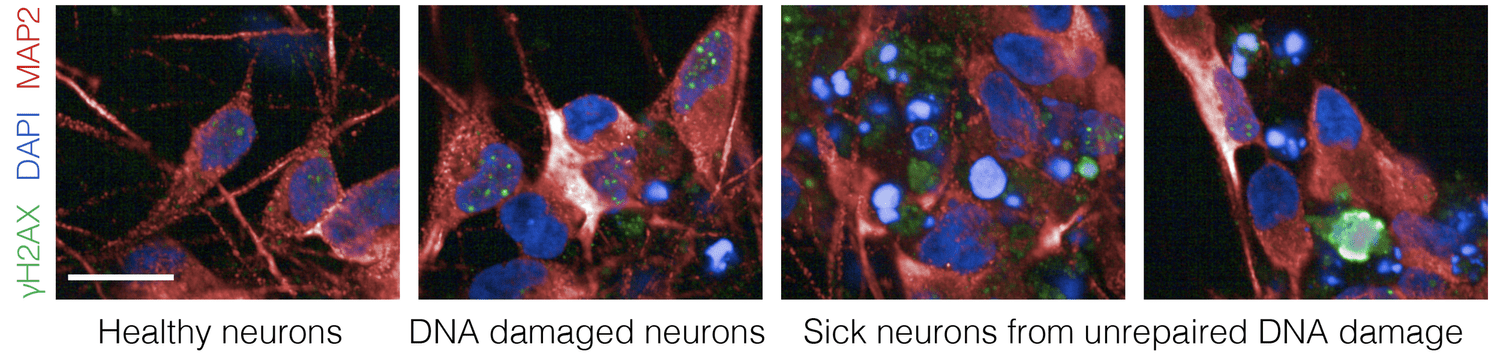
Our approach combines CRISPR–Cas9 screening, human stem-cell-derived neuronal models and mouse models. We study Huntington’s disease, ALS and frontotemporal dementia, ataxia telangiectasia, and Parkinson’s disease. We also work on the naked mole-rat to investigate brain ageing and the mechanisms that may support long-term neuronal resilience.
Our researchLinking DNA damage and repair to the selective loss of cortical neurons.
Explore the findingReducing MSH3 stalled CAG repeat expansion in patient-derived neuronal models.
Explore the findingA human model reveals early cellular changes and enables tests of potential interventions.
Explore the findingDNA repair pathways and the control of CAG repeat expansion.
Find out more02Genome instability and DNA damage responses in vulnerable neurons.
Find out more03The role of ATM in neuronal genome stability and damage responses.
Find out more04Oxidative stress, mitochondrial integrity and neuronal survival.
Find out moreWhat the naked mole-rat can teach us about genome stability, neuronal resilience and healthy brain ageing.
Explore our ageing research
Research Assistant and PhD student - in collaboration with Transylvanian Institute of Neuroscience
View profile
Research Assistant

Scientific researcher - in collaboration with Transylvanian Institute of Neuroscience
View profile
PhD Student

PhD student
View profile
Research Assistant

Research Assistant and PhD student

Research Assistant
· Preprint
Our collaborative bioRxiv preprint presents a telomere-to-telomere naked mole-rat genome assembly, annotated using data from 23 tissues. The resource enables studies of genome stability and the genetic basis of the species’ distinctive biology.
Read the bioRxiv preprint· Publication
A collaborative study with the Jackson Laboratory identifies epigenetic regulators that can restore sensitivity to ATR inhibition in experimental cancer models.
Read the paper· Research programme
Gabriel Balmus and Sarah Tabrizi are advancing a project supported by stage II of the UK DRI Key Questions programme, aiming to identify compounds that selectively target DNA repair pathways involved in CAG repeat expansion.
Read the UK DRI announcement